
Tree heroes: Daniel Misaki
Daniel Misaki lives in Western Uganda between Queen Elizabeth National Park and the Rwenzori Mountains National Park, two beautiful but deeply degraded landscapes. Daniel shared with ITF his journey from poacher to environmentalist.
Daniel is from a family of poachers in Uganda. His parents, friends and community went into the parks illegally. Some to poach animals, others to cut down wood to make charcoal. For many, poaching wasn’t a choice, it was the only way to earn a living. It’s Illegal and dangerous and some of his friend’s lost their lives to it.
But the loss to the community goes even deeper.
“With the decreasing forest cover here we are now experiencing landslides because our area is mountainous,” says Daniel. “Rainy season is now described by landslides and floods. Homes are being blown down too, including mine. Without the trees wind travels with a very high speed, clearing everything that comes across its way. Every year we are burying people.”
A generation ago, farmers could grow and sell enough food, like beans and maize, to provide for their family and pay their children’s school fees. But now, crops are failing.
“The whole water cycle depends on the trees,” Daniel says. “They help form the rain, store it in the soil and push it back to the atmosphere. We are depending totally on rain and without rain everything is failing. Then the high impact is on livelihoods. We're a farming community.
“With the deteriorating forest, we are now starving. Farmers cannot actually afford to pay fees for their children and the school dropout rate is increasing. Because some men cannot afford the daily food for their homes, they are tortured and men are taking their lives. For example, in Karambi where I live, two people die by suicide every year.”
Changing mindsets
While still a teenager, Daniel started learning about environmentalism and his whole life changed. He knew he wanted to be a conservationist. He started a wildlife club at school to mobilise other students. Then he went to a college that specialises in the wildlife and natural resource management.
Now twelve years later, at just 29 years-old he has founded and leads Ihandiro Youth Advocates for Nature (IYAN) - an organisation dedicated to promoting the sustainable use of natural resources and turning the tide on the degradation and poaching in his community.
Daniel believes that change starts with educating the children. By teaching children about the delicate balance of our planet, not only will a new generation grow up respecting trees and promoting the environment, they will go home and tell their parents, helping to transform the mindset of the whole community.

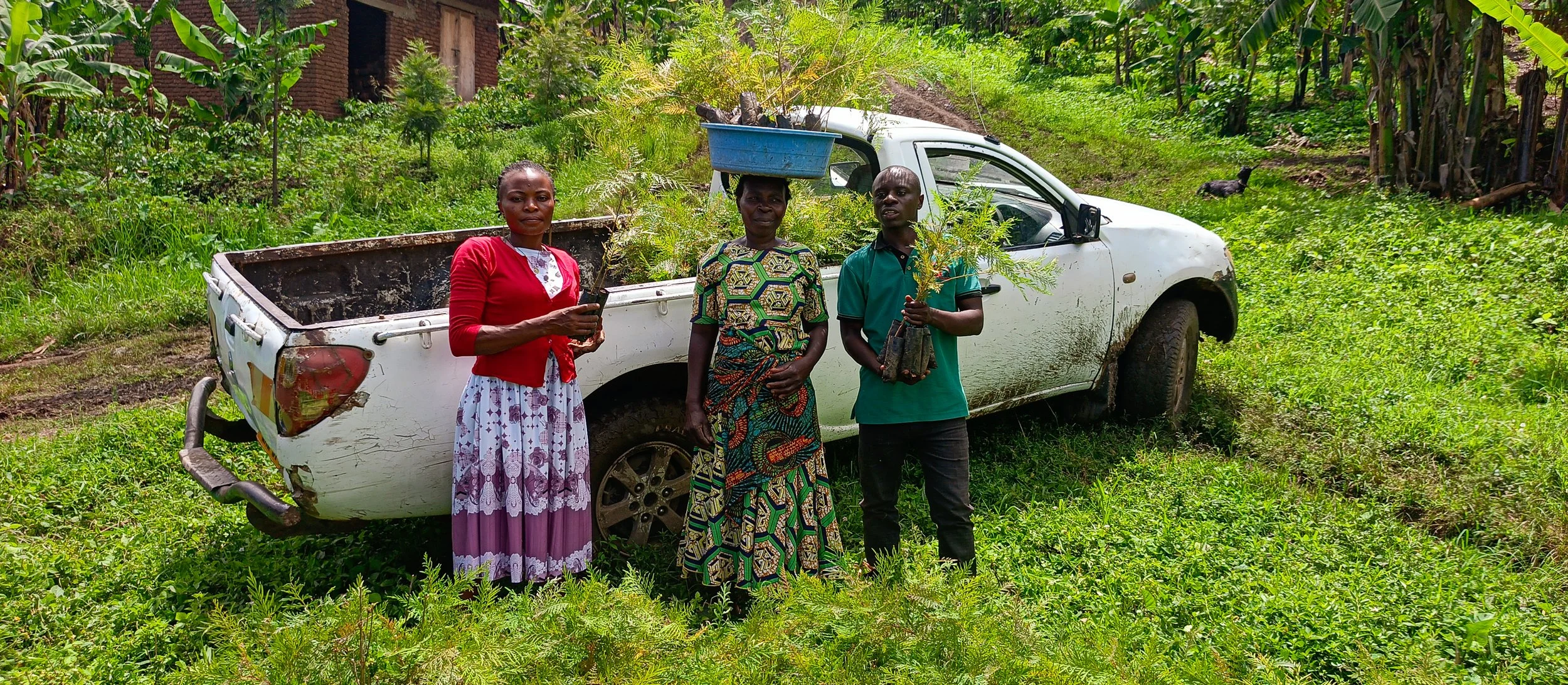
With support from ITF, Daniel and IYAN have planted over 6,000 trees within 10 schools. Trees that provide shade for students to sit under, stop dust, clean the air, provide fruit and valuable teaching opportunities, from potting, planting, tree maintenance and helping to expand the tree nursery. “We are concentrating on changing the mindset of these children,” says Daniel. “We're creating that feeling where someone says, the environment belongs to me.”

One success story is a student called Mbusa Seiz, who was so inspired by Daniel’s work at his school he went on to get his Bachelor of Science in Agriculture. He is now working to help mitigate the worst impacts of climate change on agriculture.
'We need trees'
Daniel is seeing the change in the wider community too. “Now with scarce rains, people can see there is rain in the national park, where there are trees. But it doesn’t touch the community land. So people have seen it practically that where there are trees there will be rain.
“We have now started to plant trees in the homes of these children because the parents said, ‘we need the trees, you're telling us not to go to the park, but we need the trees so that we can have the branches from these trees’. In the March to June planting, we planted 15,500 trees.”
Be a tree hero
Every 15 minutes around 36,000 trees are cut down worldwide. Trees that provide oxygen, store carbon, protect wildlife and sustain people’s lives.
While the problem is global, solutions must be local. In many large-scale campaigns, up to half of the trees don’t survive - poorly chosen species, planted in the wrong places left without the care and protection that they need.
That is why ITF works with local communities and local tree heroes to plant trees and restore forests in places where, together, we can make the fastest, most lasting impact for communities and the future of our planet.
Can you imagine a world without trees? Neither can we. Join the restoration movement with a donation today.
This article first appeared in the 82nd Issue of ITF’s journal, Trees.